
NEWS
Black AI launches the Physical RSI Lab to build robots that improve themselves in the physical world
Today, we are excited to announce that Black AI has founded the Physical RSI Lab in Tokyo.
RSI stands for recursive self-improvement: a system uses its own experience to improve itself, and the improved system is better at the next round of improvement. The lab's job is to bring this into the physical world: AI that learns by trial and error on real robots, improves on its own, and keeps what it learns as reusable capabilities. We believe the growth of robot capabilities should not stay bounded by how much data people can collect or how much code they can write.
Progress so far and what comes next
The lab is not starting from scratch. The RSI framework we have built in-house already beats the published state of the art on some tasks, and we are now validating it on real robots. We plan to release the framework and offer it as a service.
Our work so far is described in two technical reports: "Physical RSI: Self-Improving Robot Control Programs with Agent-as-a-Policy and Tree Search" and "Taking Physical RSI to Real Robots: The Sim-to-Real Gap and How We Cross It." We are now applying Physical RSI to the algorithms of our manufacturing customers' real material handling systems.
Why now
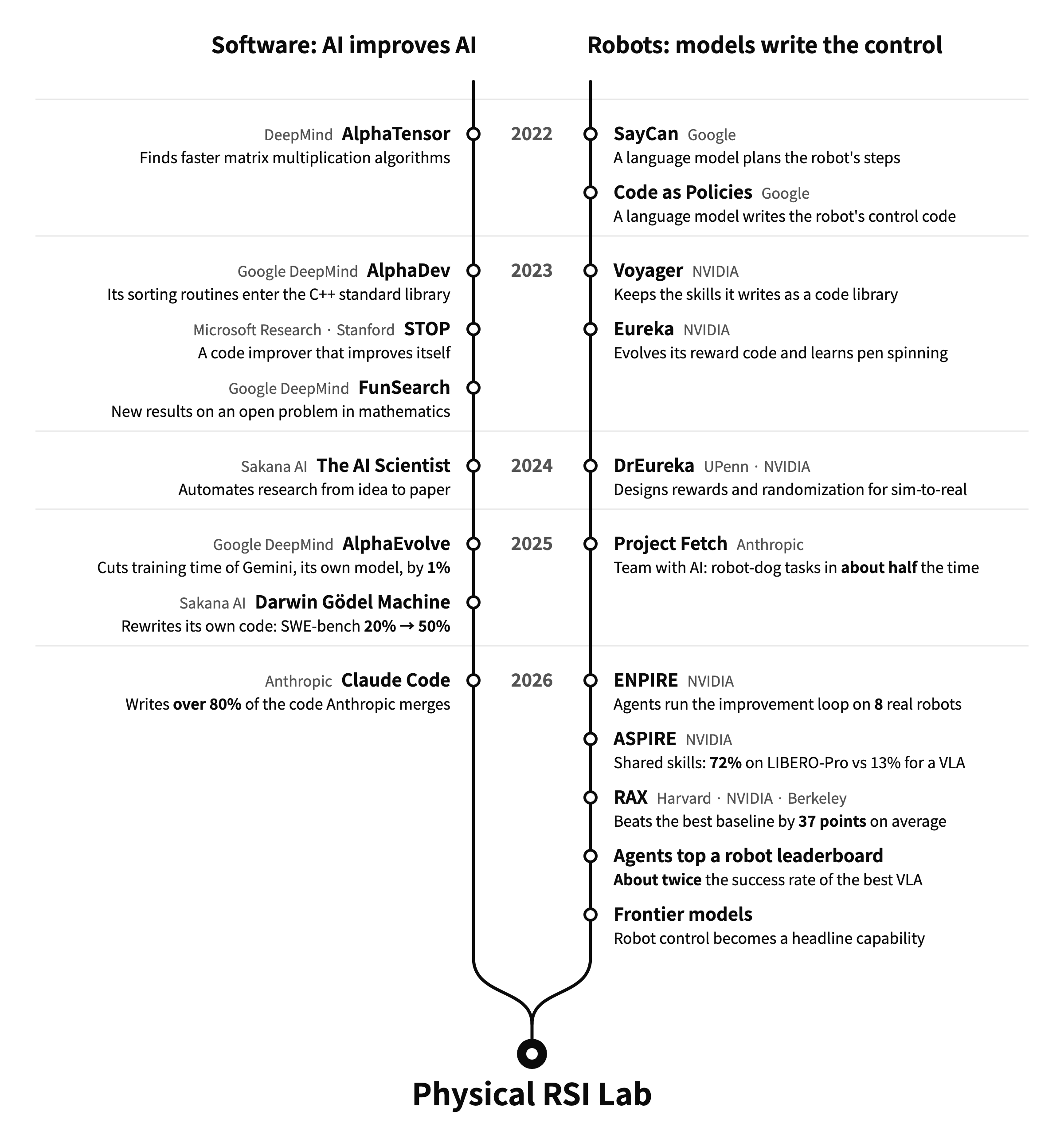
Self-improvement is already real in software. In 2025, Google DeepMind's AlphaEvolve used evolutionary search to improve a compute kernel used to train Gemini↗, and Sakana AI's Darwin Gödel Machine rewrote its own code to raise its SWE-bench resolve rate from 20% to 50%↗. Anthropic has disclosed that Claude writes more than 80% of the code merged at the company↗.
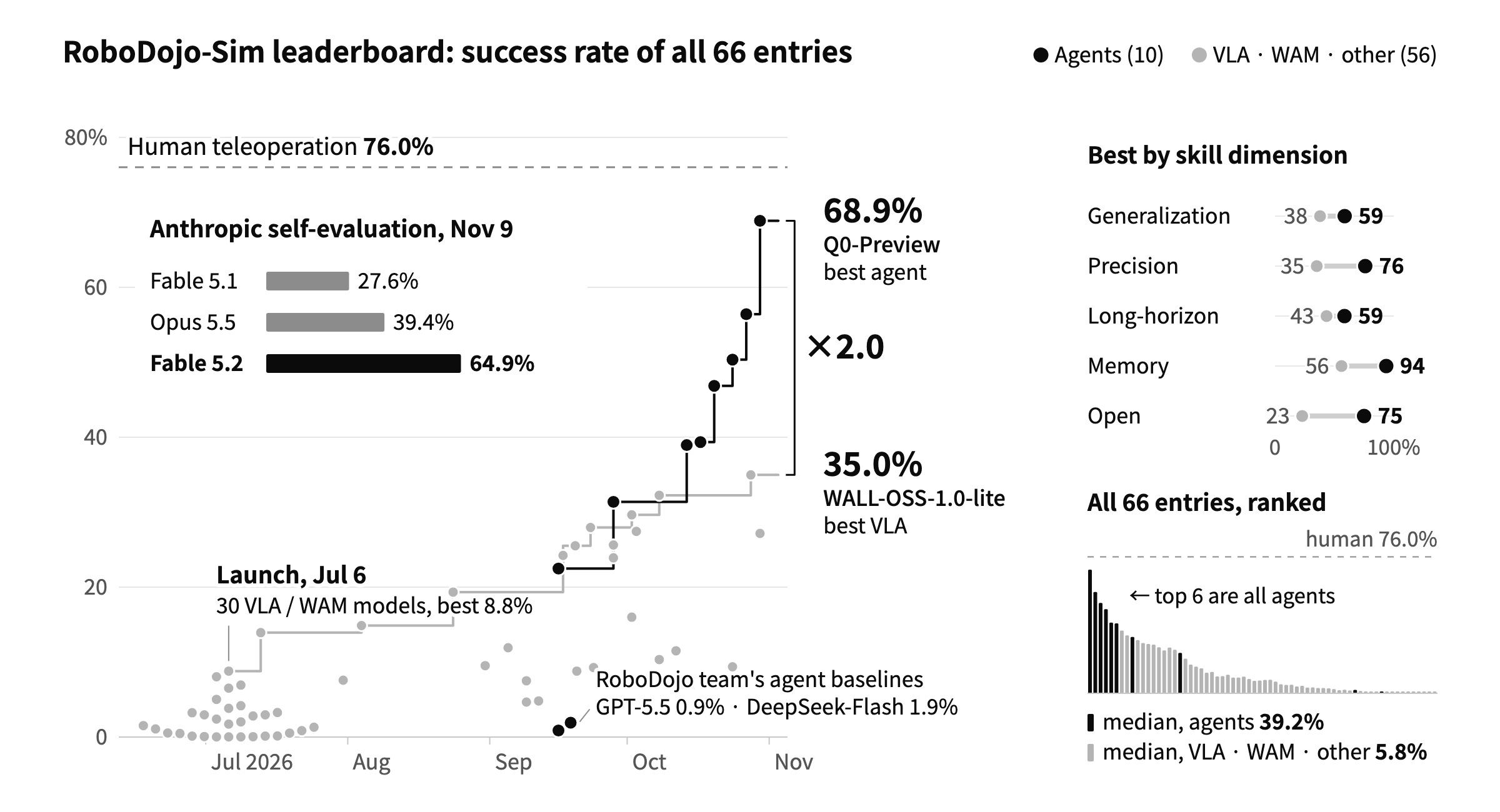
Robot learning, meanwhile, has been stuck on data. The dominant approach, end-to-end VLA (vision-language-action) models, needs more than ten thousand hours of human demonstrations and is still brittle. In the LIBERO-PRO evaluation, models that succeed more than 90% of the time under standard settings can drop to 0% when object positions or instructions change slightly↗. On a manipulation benchmark released this year, the best of 30 VLA/WAM policies succeeded 8.8% of the time, against 76% for human teleoperators↗.
That changed in 2026. NVIDIA, UC Berkeley, Stanford, Harvard and others released a wave of work in which coding agents operate robots, write their own control programs and improve from their own failures. On that benchmark's public leaderboard, an agent-based method now holds the top spot, succeeding about twice as often as the best VLA↗, and new benchmarks have appeared to evaluate robot control by large models↗. Claude Fable 5.2, released on November 9, names control of physical robots as one of its key capabilities↗. Progress in robotics is becoming tied to progress in large models.
But no one has yet closed the loop in the physical world. A recent survey divides physical RSI into six levels, from L0 to L5, and concludes that no existing work reaches physical RSI in the full sense↗. Getting a self-improvement loop to run on real robots, and to keep running, is the problem the Physical RSI Lab was founded to solve.
Why Japan, and why us
Japan is the center of the world's robot manufacturing. According to the International Federation of Robotics (IFR), Japan produces about 38% of the world's robots↗. It is also one of the first countries to face a shrinking workforce: the Recruit Works Institute estimates that Japan will be short of more than 11 million workers by 2040↗. In Japan, robots are not a future option but a present need. And the biggest cost of putting a robot to work is setup: reprogramming, re-teaching and re-tuning for every new task and every new production line. If AI can take over that process itself, robots will reach the workplace far faster.
Black AI is based in Tokyo and develops its own humanoid robots. Large-scale simulation infrastructure, real-robot test stations and our own hardware all sit in one team. We intend to bring Physical RSI to many more workplaces through our humanoids. The more widely the robots are used, the more experience Physical RSI gains in the real world; the improved capabilities go back into the robots, which can then take on more work. Keeping that cycle turning is our long-term path.
Research directions
- Agent-as-a-Policy. Coding agents built on large language models operate robots directly, write the control programs and fix them from their own failures. What works is kept as programs and skills that people can read, check and reuse on other tasks.
- Evaluation that stays true to reality. How far self-improvement can go depends on what it counts as an improvement. We keep aligning the simulator with reality using data from real robots (real-to-sim), so that an improvement in simulation is also an improvement on the real robot.
- Reusing skills across tasks and robots. A skill that one robot has learned should carry over to other tasks and other robots, humanoids included, so that a new site does not have to start from scratch.
- Safety and verifiability. Held-out tests kept separate from development, programs that stop themselves when they judge a situation unsafe, and a history of every change. To use a self-improving system on a production floor, you have to be able to check what changed and why it got better.
- Making improvement itself efficient. Lower the cost of each trial and make past experience easy to retrieve when it is needed. Eventually, the way improvement is carried out becomes something the system improves as well.
We do not expect VLAs to be the final answer. Meeting real-world demands with a VLA alone means people keep carrying the data collection, the evaluation and the redoing of failed work. End-to-end models are still useful as components of a self-improvement loop: the agent can decide when to call them, what data to train them on and how to evaluate them.
"VLAs have advanced rapidly over the past two years, but they still show little sign of generalizing. The agent approach still has many problems, such as run time and fluency, yet it is the first thing that has made me truly feel that a zero-shot breakthrough in physical AI is possible. Going forward, Black AI will focus its research on Physical RSI and, together with our own humanoid, seek new possibilities that do not depend on on-site data."
We're hiring!
We are looking for people who want to help bring self-improvement into the physical world:
- Researchers in robot learning, reinforcement learning and manipulation planning
- Engineers in large-scale simulation, real-to-sim and system identification
- Engineers working on coding agents and evaluation infrastructure
- Engineers for real-robot systems and hardware integration
Related technical reports
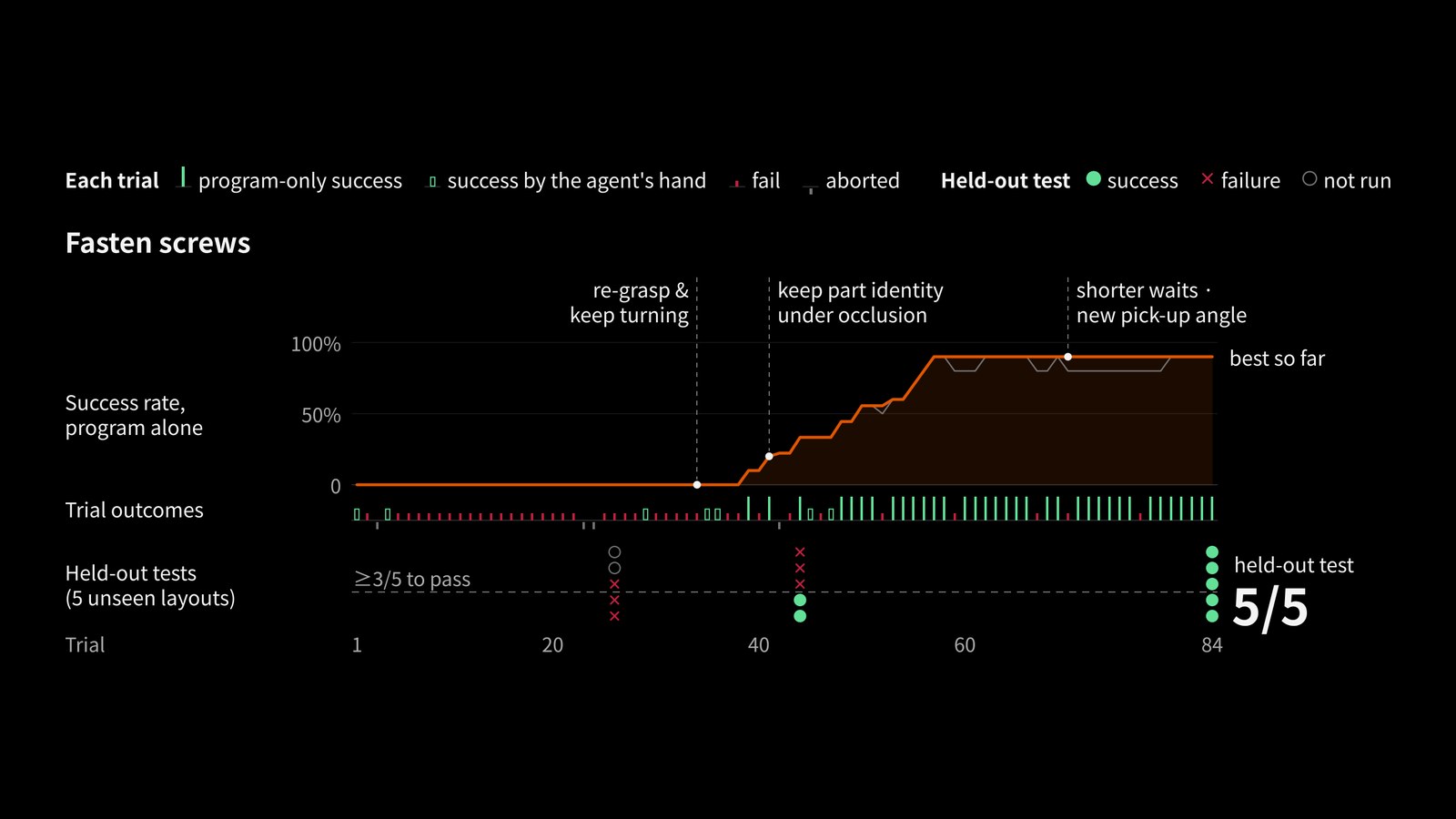
Physical RSI: Self-Improving Robot Control Programs with Agent-as-a-Policy and Tree Search
End-to-end VLAs are still brittle on new layouts, long tasks and precise tasks, and every improvement means collecting more data and retraining. This post introduces Physical RSI, which adds a self-improvement loop to coding agents used as robot policies.
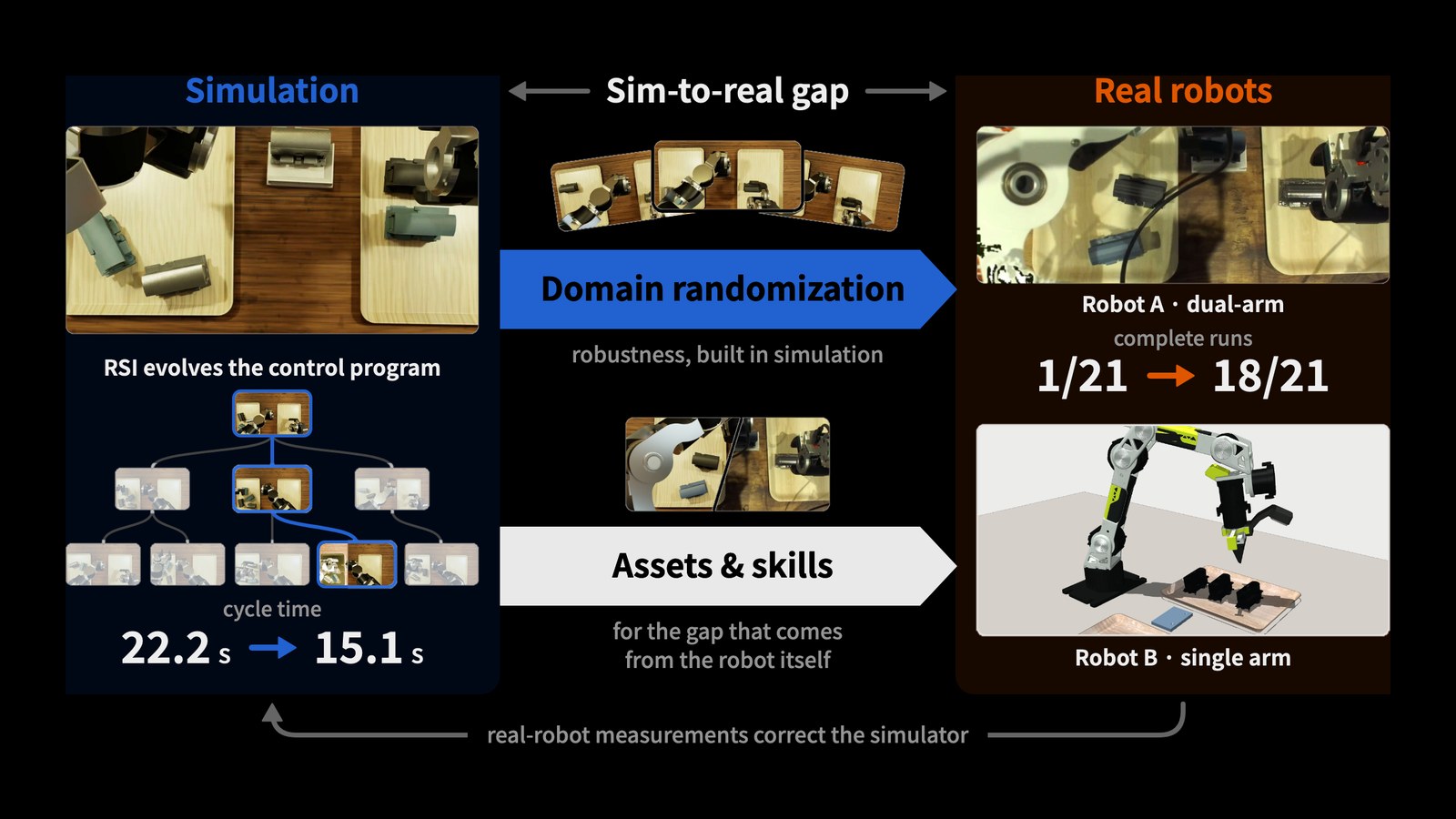
Taking Physical RSI to Real Robots: The Sim-to-Real Gap and How We Cross It
In simulation, RSI cut the cycle time of a dual-arm pick-and-place task with a peg-insertion step from 22.2 s to 15.1 s.