BLOG
Physical RSI: Self-Improving Robot Control Programs with Agent-as-a-Policy and Tree Search
TL;DR
- VLA performance depends heavily on demonstration data. Even counting data from lightweight collection setups such as EGO and UMI, the data gathered so far can hardly support VLA generalization or long-horizon ability, and many people now think VLA progress has hit a bottleneck.
- Agents, however, have brought a breakthrough in robot manipulation: GPT-6 Astra and Claude Fable gave robots, for the first time, a zero-shot manipulation ability that VLAs cannot yet match. Physical RSI goes a step further and hands the improvement loop to a coding agent (Agent-as-a-Policy). In simulation, the agent operates a dual-arm robot by trial and error, writes what works into a control program, and records what it learned in memory. The program's versions form a search tree that a tree-search algorithm advances. There are no demonstrations and no weight updates.
- On a few hard RoboDojo tasks, the policies evolved by our Physical RSI framework, running on their own without the agent, surpassed previous state-of-the-art methods on some of them.
- For real-robot experiments and attempts at real industrial applications, see the follow-up post.
1. VLAs are strong, but the way they improve has a ceiling
VLAs are a remarkable engineering achievement. From RT-2, which fine-tuned a vision-language model directly into a network that outputs actions, through OpenVLA, π0, π0.5 and GR00T, this line of work has shown that, given enough data, a single network can go straight from pixels and a one-sentence instruction to motor commands.
Two years on, however, we are increasingly convinced that the bottleneck for VLAs lies in how they improve, rather than in model size.
First, data is hard currency, and it keeps getting more expensive. Pretraining π0 used more than 10,000 hours of robot data, which the paper called the "largest robot learning experiment" at the time (Black et al., 2024). By the end of 2025, one company claimed to have accumulated 270,000 hours of real-world manipulation data (Generalist GEN-0). Even so, the standard practice for a new task is still to collect another 50 to 100 demonstrations for fine-tuning (Gemini Robotics On-Device).
Second, change the layout and they stop working. LIBERO-PRO found that models with success rates above 90% on standard LIBERO can drop to 0% when object positions, instruction wording or the environment are perturbed even slightly (Zhou et al., 2025). In LIBERO-Plus, a change in camera viewpoint alone dropped OpenVLA's success rate from 76.5% to 1.1% (LIBERO-Plus). The authors attribute this to the models memorizing trajectories rather than learning the tasks.
Third, long-horizon and high-precision tasks are where they struggle most. The 2025 BEHAVIOR Challenge provided 10,000 teleoperated demonstrations, and the winning entry still reached only 12.4% full-task success (BEHAVIOR Challenge 2025). The paper introducing RoboDojo, a dual-arm manipulation benchmark released in 2026, points out a typical failure mode on precision tasks: the key is already going in crooked, and the policy keeps pushing it in. This shows that the policy cannot correct its actions based on the current state (Chen et al., 2026).
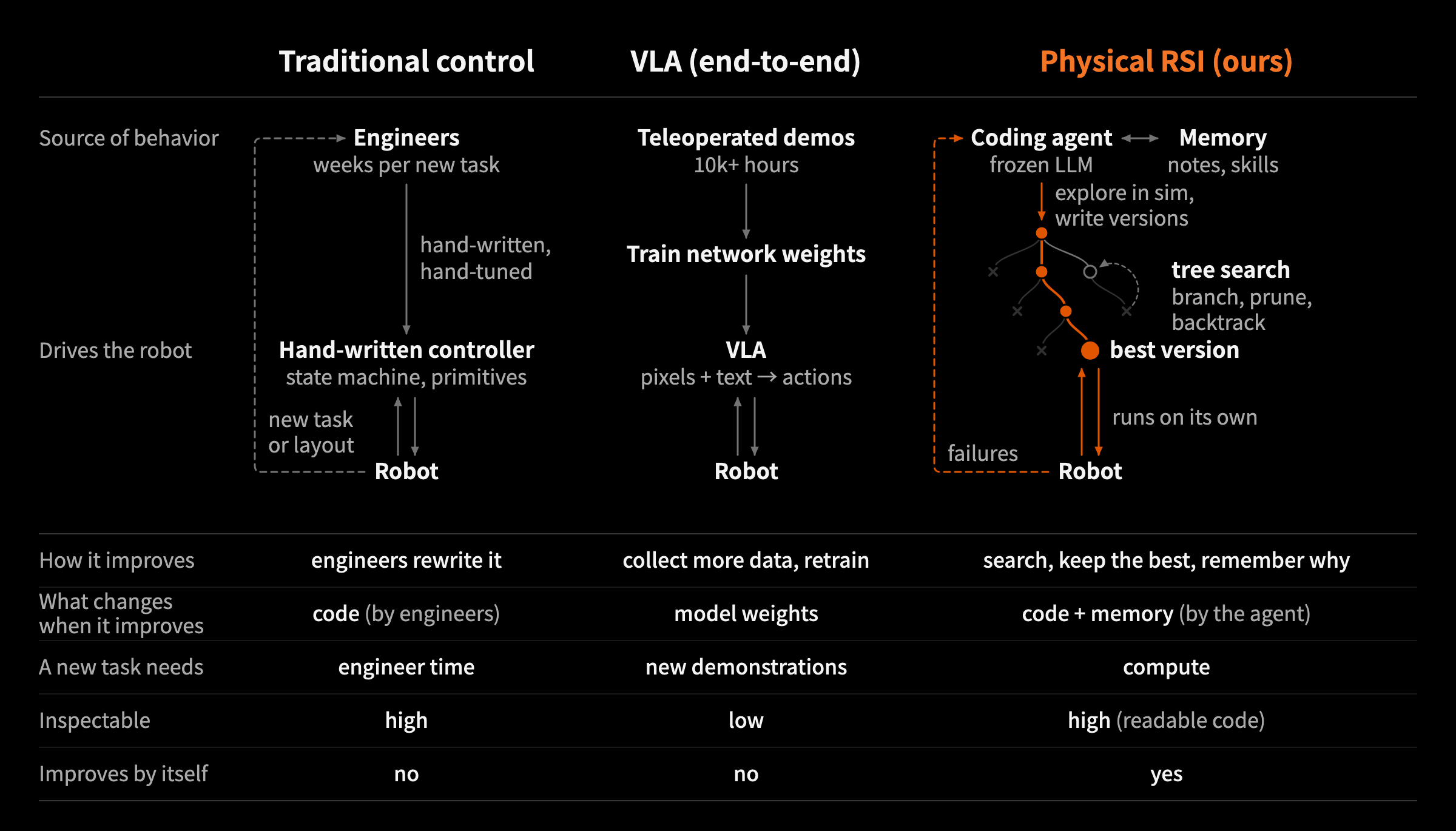
Fourth, they are black boxes. When a VLA fails, it is hard to say why. Fixing it almost always means collecting more relevant data and training again.
The four problems share a cause. In the VLA improvement loop, people do every step: they collect the data, decide what data is needed, evaluate the model after training, find new failures and go back to collect more. As a result, people set the upper limit on how fast the model improves. The model does not get better just by attempting a task more times.
2. Another path: let the agent itself be the policy
Another option is to leave the foundation model as it is, instead of fine-tuning it into an action network, and have it reason directly about how to operate the robot.
The idea is not new. In 2022, SayCan had a language model choose from a set of predefined skills. Code as Policies, from the same year, had the model write Python programs that call perception and control interfaces directly. In 2023, Voyager had an agent in Minecraft write the skills it learned as code, store them in a skill library and reuse them later. VoxPoser, and later ReKep, had the model describe spatial constraints in code and hand them to an optimizer to solve. Eureka had the model write reward functions and kept improving them with evolutionary search.
Before 2024, though, this line of work was generally seen as producing "fun demos." The code the models wrote was too fragile and fell apart once tasks got long.
The turning point came between 2025 and 2026, when two things matured at the same time:
- The visual reasoning and coding abilities of foundation models crossed a threshold. Coding agents that can work for hours at a stretch, reading their own logs, editing their own code and checking their own work, went from research prototypes to everyday tools. METR's measurements show that the length of tasks frontier models can reliably complete doubles roughly every 3 to 7 months (METR, 2026).
- Researchers began giving agents a "robotics toolbox": depth back-projection, inverse kinematics, motion planning and collision checking. The agent does not have to guess joint angles from pixels. It can call these tools the way an engineer would.
The result was a dense wave of work in 2026:
- Gemini Robotics 1.5 turned an embodied reasoning model into an "orchestrator" that first thinks the problem through and then calls an action model to carry it out (Google DeepMind, 2025).
- CaP-X systematically evaluated how well coding agents control robots at different levels of abstraction. It found that a code agent with no training at all already matches π0.5 under position perturbations and is far more robust to reworded instructions (CaP-X, 2026).
- ENPIRE (NVIDIA and others) had coding agents run their own "reset, execute, verify, improve" loop on 8 real dual-arm stations, reaching 99% on several tasks under pass@8 (a task counts as solved if at least one of 8 attempts succeeds) (ENPIRE, 2026).
- ASPIRE (NVIDIA and others) had multiple agents explore more than 150 simulated tasks in parallel and distill their debugging experience into a shared skill library. It reached 72% on LIBERO-Pro, against 13% for π0.5 (ASPIRE, 2026).
- Agent as Policy uses coding agents such as Codex and Claude Code directly as policies on real robots (AGP, 2026). Another paper found that GPT-6 Astra, without any robot training, outperformed all 40 public policies on RoboDojo (An Unexpected Robot Policy, 2026).
- RAX (Harvard, NVIDIA, Berkeley and others) has a frozen coding agent explore online and compiles successful decision sequences into standalone robot programs, while maintaining notes and a versioned skill library. Across five simulation benchmarks, it beats the best baseline by an average of 37.4 percentage points (RAX, 2026).
New proving grounds: benchmarks for agents that operate robots
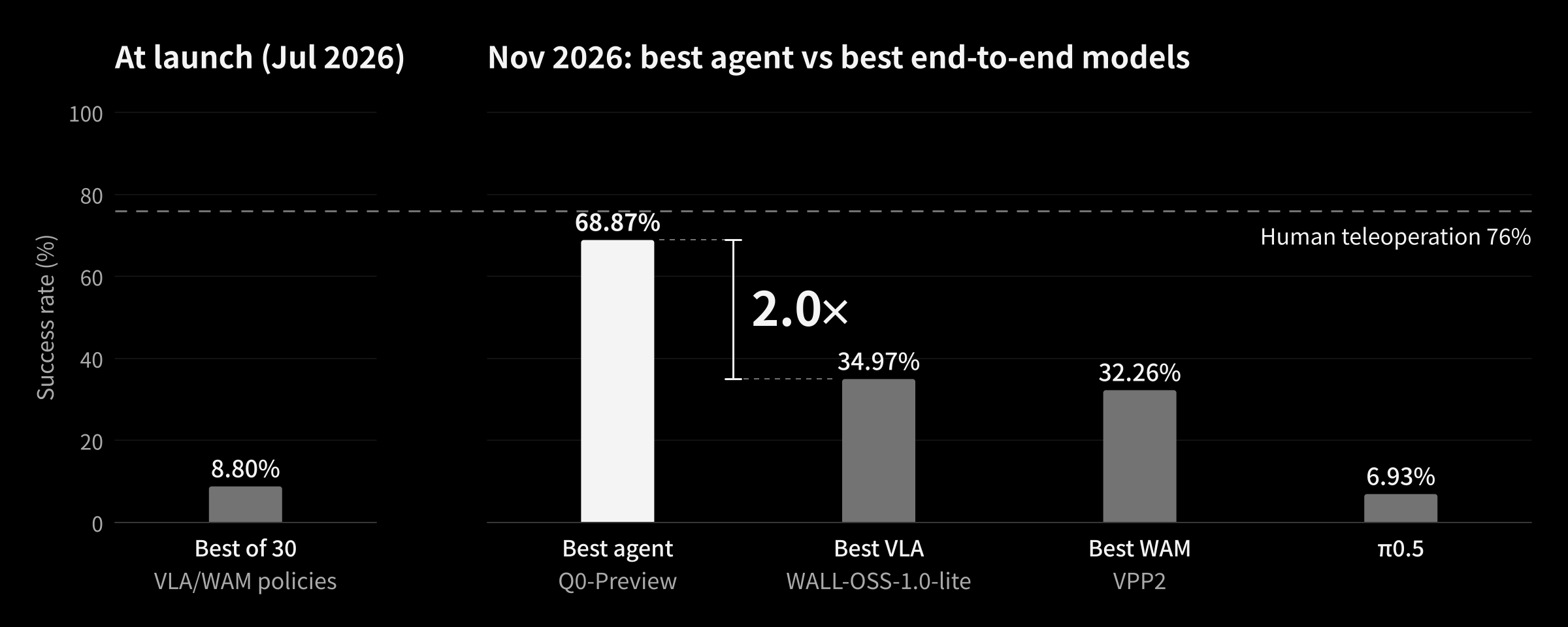
In the second half of 2026, a cluster of benchmarks and leaderboards appeared that specifically evaluate foundation models and agents controlling robots directly. Dedicated evaluations like these are a sign that the field has gained momentum. On the RoboDojo agent leaderboard, the top entry already succeeds about twice as often as the best VLA (Figure 3).
| Benchmark / leaderboard | Who runs it | What it tests | Current results |
|---|---|---|---|
| RoboDojo agent leaderboard | RoboDojo team; listing agents since September 2026 | 42 dual-arm tasks in simulation | Top entry Q0-Preview at 68.9% success; the best VLA on the main leaderboard is at 35.0% |
| AA-Robotics v0.1 | Artificial Analysis, October 2026 | 8 zero-shot tasks on a real 6-axis robot arm, with models operating it from a coding-agent environment | GPT-6 Astra 69.4, GPT-6.1 Sol 64.6, Gemini 4 Argon 55.3, Opus 5.5 48.8, Fable 5.1 46.3 (out of 100) |
| RoboLab-120 | NVIDIA, 2026 | 120 tabletop tasks in Isaac Lab | The top two entries are both "agentic language models." In NVIDIA's report, GPT-6 Astra run as an agent reaches 74.8% success, against 28.0% for π0.5 (Astranomy) |
| The Bitter Lesson Comes to Robotics | Independent research, October 2026 | Frontier models completing 6 tasks taken from RoboDojo on a real dual-arm robot | From July to October 2026, the best score doubled roughly every 54 days |
Anthropic released Claude Fable 5.2 on November 9, 2026, and the announcement states plainly that the new model is significantly better at controlling physical robots (Anthropic, 2026). In Anthropic's internal tests (same harness, highest reasoning effort), Fable 5.2 reached 64.9% in RoboDojo simulation, compared with 39.4% for Opus 5.5, 29.8% for GPT-6 Astra and 27.6% for the previous Fable 5.1. These are vendor-reported numbers and do not appear on the official leaderboard. Still, the gap is large: each foundation model upgrade moves robot capability up a level without a single new demonstration being collected. We think this would be hard to achieve on the VLA path.
These benchmarks also have weaknesses. AA-Robotics results have not yet been independently reproduced, and a model takes about 30 minutes on a task a person finishes in 20 seconds. Protocols also differ from benchmark to benchmark, so results cannot be compared directly.
Two forms, and our choice
VLM-as-a-Policy keeps the model "online" at every step: look at the image, think, and output the next action. Actions themselves are also starting to look more like language. VLA-0 has a vision-language model write actions directly as a string of integers (VLA-0, 2025). In Show-Harness, the VLM picks from semantic action units such as "move forward," "rotate about an axis," "grasp" and "release," and a deterministic interpreter converts them into pose deltas for the robot, with no action head and no special tokens. On fine-grained control tasks, zero-shot Gemini 3.1 Pro reaches 82%, while π0.5 trained on the same demonstrations reaches only 18% (Show-Harness, 2026). If actions can be written as strings, the line between VLAs and VLMs blurs, and an action head is no longer something only VLAs have.
With Agent-as-a-Policy, the agent does more than make step-by-step decisions: it writes programs, runs them, reads the logs and revises them, and in the end distills what works into code that can run on its own, without the agent. Figure 1, at the top of this post, compares classical control, VLAs and our Physical RSI. Physical RSI combines Agent-as-a-Policy with a self-improvement loop; Sections 3 and 4 describe it in detail.
We chose Agent-as-a-Policy, for the following reasons:
- Generalization comes from reasoning rather than memorization. Under the same perturbations, VLAs fall from above 90% to 0%, while code agents hold at 72% to 84% on LIBERO-Pro (ASPIRE, RAX).
- No demonstrations and no weight updates. What gets improved is code and memory, so every step can be read, reviewed and rolled back.
- It gets stronger as foundation models do. When ASPIRE switched its base model from Claude Opus 4.6 to Opus 5.5, its LIBERO-Pro success rate rose from 72% to 99%. In Anthropic's own RoboDojo simulation tests, the score more than doubled in a single minor version, from Fable 5.1 to Fable 5.2. For a VLA to benefit from progress in foundation models, it has to be retrained. An agent only needs to switch models.
- Capability scales with test-time compute. When RAX raised its exploration budget from 2 to 32 trials, its success rate on DexJoCo, a benchmark for multi-fingered hand manipulation, rose from 31.9% to 96.7%. Performance can now be raised by adding compute instead of human labor.
- Experience can be stored, reused and made cheap. Once it is compiled into a program, execution no longer needs a large model. RAX reports an air-fryer task going from 72 minutes of hands-on operation by the agent to 18 seconds of program execution.
Its weaknesses are just as clear: slow reactions (each call to a large model takes over ten seconds), difficulty with closed-loop contact control, the gap between simulation and real hardware, and a sizable token bill. We address these in Section 8 and in our next post.
Where we think VLAs are headed
In 2026, the debate over the future of VLAs spread from individual labs to the wider community.
- "VLAs are already obsolete." Jim Fan, who leads embodied AI at NVIDIA, argues that VLAs adapted from vision-language models are mismatched by design: the backbone is optimized for visual question answering, and the encoder throws away the low-level detail that manipulation needs. In public talks in 2026, he has argued for a shift to world action models (WAMs) and described "automated research in the physical world" as the endgame (36Kr, Eventual).
- "The frontier model itself is the best policy." An analysis published on both arXiv and LessWrong estimates that the ability of frontier models to control robots doubles roughly every 54 days. On six dual-arm tasks taken from RoboDojo, frontier models already outperform the best specialized VLA the study tested, and the bottleneck has shifted from whether the model can reason to whether it can reason fast enough. The analysis also acknowledges that its sample is limited (LessWrong, 2026).
Here is our own view.
First, the gap between discrete tokens and continuous actions does make it hard for large models to control robots directly without an action head. Early in many tasks, the agent tries to drive the arm directly by outputting spatial commands, but this proves too slow and too unstable. However, an agent's strength lies less in step-by-step decisions than in writing programs, reading failures and accumulating experience. What it works out through slow, expensive reasoning can be kept as a program that runs fast and cheaply. As we will see in Section 5, what finally runs in the held-out tests is a sufficiently capable Code-as-a-Policy program (an approach that uses code as the policy). Some argue that Code-as-a-Policy may not adapt well enough for dynamic tasks that demand very strong generalization. We think the corner cases that Code-as-a-Policy cannot cover can be handled, to a reasonable degree, by an agent that controls the robot on the fly with the help of reusable skills.
Second, VLAs will move down the stack. They will become components that agents call, evaluate and fine-tune. Once actions can be written as strings and executed smoothly through code, the gap between discrete tokens and continuous actions closes, and the last thing that sets end-to-end models apart fades with it.
3. Why RSI, and why now
The idea of recursive self-improvement (RSI) goes back to I. J. Good's 1965 "intelligence explosion," a chain of improvements driven by machines that design machines better than themselves, and to Schmidhuber's 2003 Gödel machine, which rewrites its own code only when it can prove the rewrite is beneficial. For a long time, these ideas remained theory. After 2023, self-improvement in software began to produce real results. STOP had a scaffolding program repeatedly rewrite its own code. AlphaEvolve used evolutionary search to find a faster matrix multiplication kernel, cutting Gemini's training time by 1% and freeing up 0.7% of Google's total compute capacity (DeepMind, 2025). Sakana AI's Darwin Gödel Machine rewrote its own agent code and raised its SWE-bench success rate from 20% to 50% (Sakana AI, 2025). The AI Scientist v2 uses agentic tree search to carry out research. In April 2026, ICLR held a workshop dedicated to RSI, whose organizers wrote that it is "no longer a speculative vision" (ICLR 2026 RSI Workshop). Also in 2026, Anthropic stated publicly that more than 80% of the code merged into its main branch is written by Claude, while cautioning that RSI is not inevitable (Anthropic, 2026).
These results rest on the same maturing of coding agents described in Section 2.
Self-improvement has also become a central theme in robotics. Sergey Levine frames the timeline for robotics around when the self-improvement flywheel starts to turn (Dwarkesh Podcast, 2025). Physical Intelligence's π*0.6 stresses that robots must learn from their own experience (π*0.6). Jim Fan, mentioned in Section 2, likewise sees "automated research in the physical world" as the endgame. These views agree that robots need to improve themselves. Where they differ is who should drive the flywheel. We believe the answer is the AI agent: it is currently the only component that can propose changes, run the verification and explain the results without a human in the loop. This is where the two lines of work meet: self-improvement in software and the use of foundation models as robot policies (Figure 4).
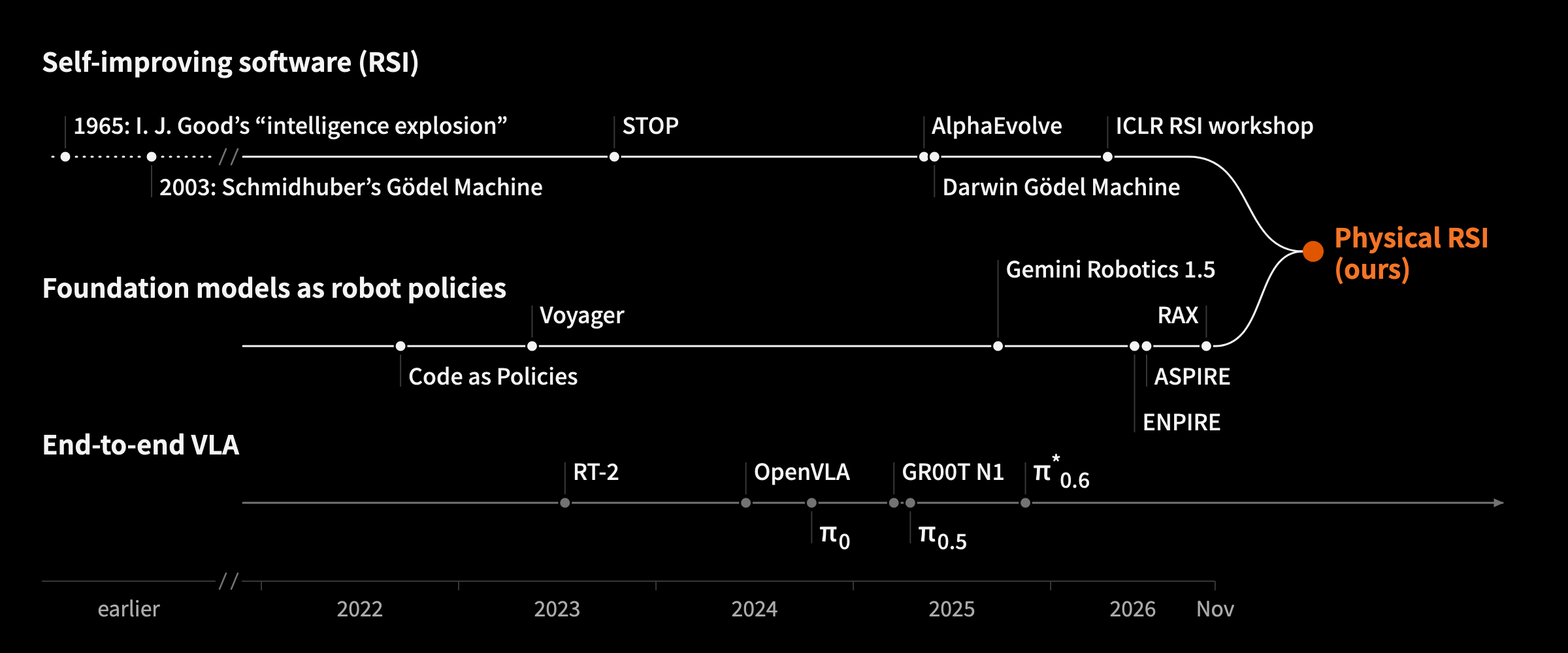
RSI has no agreed definition yet. The strict version requires a system to improve its own method of improvement, or even its own architecture and weights; the Gödel machine is the theoretical prototype of this kind. The loose version counts any loop that generates, evaluates and keeps the better result, even if what changes is only a prompt or a tool. Others argue that most current systems are just iterative optimization and do not qualify as recursive, and some say outright that RSI has become a marketing term (New Savanna, 2026).
For robotics, two recent surveys are useful references. One divides physical RSI into six levels, L0 to L5. At L1, a system autonomously updates its memory, skills, workflows or models on a single task, while the improvement method itself stays fixed. L2 also updates the improvement method. L3 and L4 require the gains to hold across tasks. L5 further requires independent controlled evidence that each improvement is more effective than the previous one (Who Improves the Robot?, 2026). The other survey defines RSI as improving "not only capabilities but also the process that produces them" (Toward RSI in Physical AI, 2026). Both conclude that no existing work has reached the highest level.
This post stays out of the debate over definitions. We care about one question that experiments can answer: given a new task, can the system keep getting better through its own trial and error, without human demonstrations and without updating model weights, and leave behind something that can be used directly next time? If it can, the growth of robot capability no longer depends on how fast people can collect data. It depends on compute and foundation models, and both are getting cheaper quickly. VLAs have a place in this framework too: the agent decides when to call them, what data to fine-tune them on and how to evaluate them.
Moving this into the physical world raises several problems that software does not have. Trial and error is slow: software tests can run thousands of times a second, while a single robot trial takes anywhere from a few minutes to tens of minutes. Failure has a cost: things fall, tip over and get stuck. Observations are incomplete: cameras have blind spots, and the arms can block the view of parts. Success signals are unreliable: "looks fastened" and "actually fastened" are not the same thing. A problem that is easy to overlook is that the layouts the agent sees again and again during development are not the ones it will finally face, so programs can easily overfit to the development environment.
4. Method: tree search over program versions
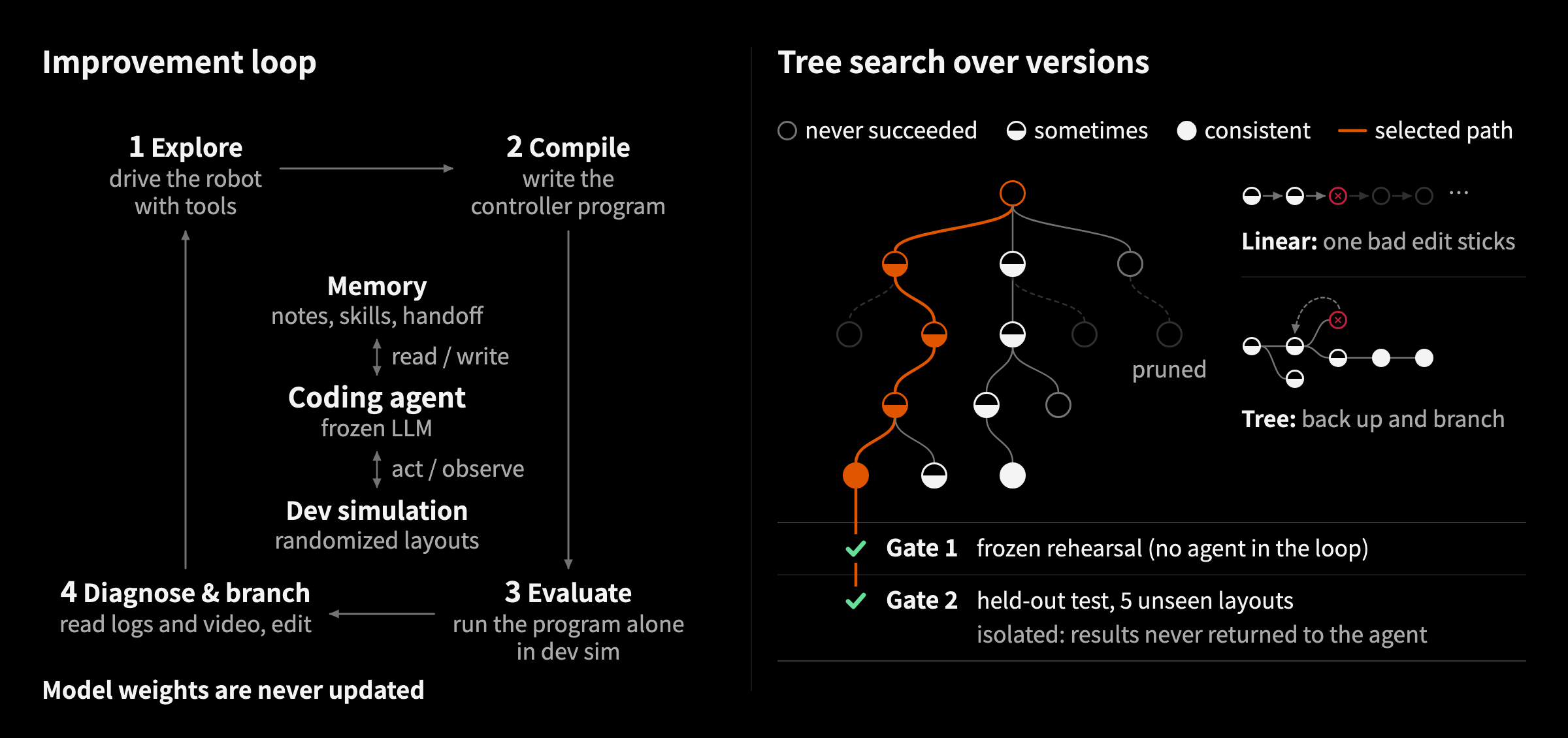
To answer the question posed in Section 3, we built the following framework. Figure 5 shows how it is organized.
4.1 What is in the system
The agent is an off-the-shelf coding agent built on a large language model, and its weights stay frozen throughout. The control program is a complete Python program that drives the robot through a cycle of observing, deciding, acting and confirming. It is also the policy we ultimately deliver. The memory consists of the agent's own progress notes, descriptions of reusable skills, and a handoff document written at the end of each trial for the next one. At the start of each trial, the agent reads its memory and then decides what to do next.
4.2 The improvement cycle
Improvement usually proceeds by repeating four steps. A "trial" here means one run of the task in simulation from start to finish (one episode), and one cycle spans several trials.
The first step is exploration. The agent issues commands through a tool interface in small increments, moving the arms and opening and closing the grippers, and checks the images after each step. It can use three RGB-D cameras to convert points in an image into tabletop coordinates with millimeter-level accuracy, and before executing a motion it can check whether the arms will collide with each other or with the table. How to measure an object's orientation and where to grasp it are up to the agent.
The second step is writing the program. Once an approach works, the agent writes it into the control program. The program checks the state at every stage and stops in a safe position if anything unexpected happens.
The third step is testing. We switch off the agent and let the program run from start to finish on a new random layout. This step tests the program itself, not the agent's ability to improvise.
The fourth step is diagnosis and revision. After a failure, the agent reviews the video and logs, finds the cause, revises the program and writes its conclusions into memory. Video 1, at the top of this post, shows the agent building up skills as it repeats this cycle.
4.3 Why tree search
Many recent systems, including RAX, use linear iteration: each iteration modifies the latest version, while experience is collected in several environments in parallel. This is simple, but if a change that looks reasonable sends the program in the wrong direction, every later version inherits the problem.
We organize program versions into a search tree. Each node is a program version together with a snapshot of the memory at that point. The agent can branch from any ancestor version that looks promising, and several branches can advance at once in parallel simulation environments. If a branch keeps regressing, it is set aside, and the agent returns to an earlier, reliable version to start again. Set-aside branches and their failure records stay in memory, so the agent does not have to go down the same path twice. Maintaining several candidates at once, selecting by performance and then continuing to modify them follows the same basic idea as a genetic algorithm. Figure 6 shows the version trees that resulted for the two tasks.
4.4 Two gates
Self-improvement can easily turn into teaching to the test. To prevent this, we set up two gates.
The first is the frozen rehearsal. The selected version is frozen and run on its own on new development layouts, and the agent is not allowed to intervene. A version that fails the rehearsal cannot go on to the held-out test.
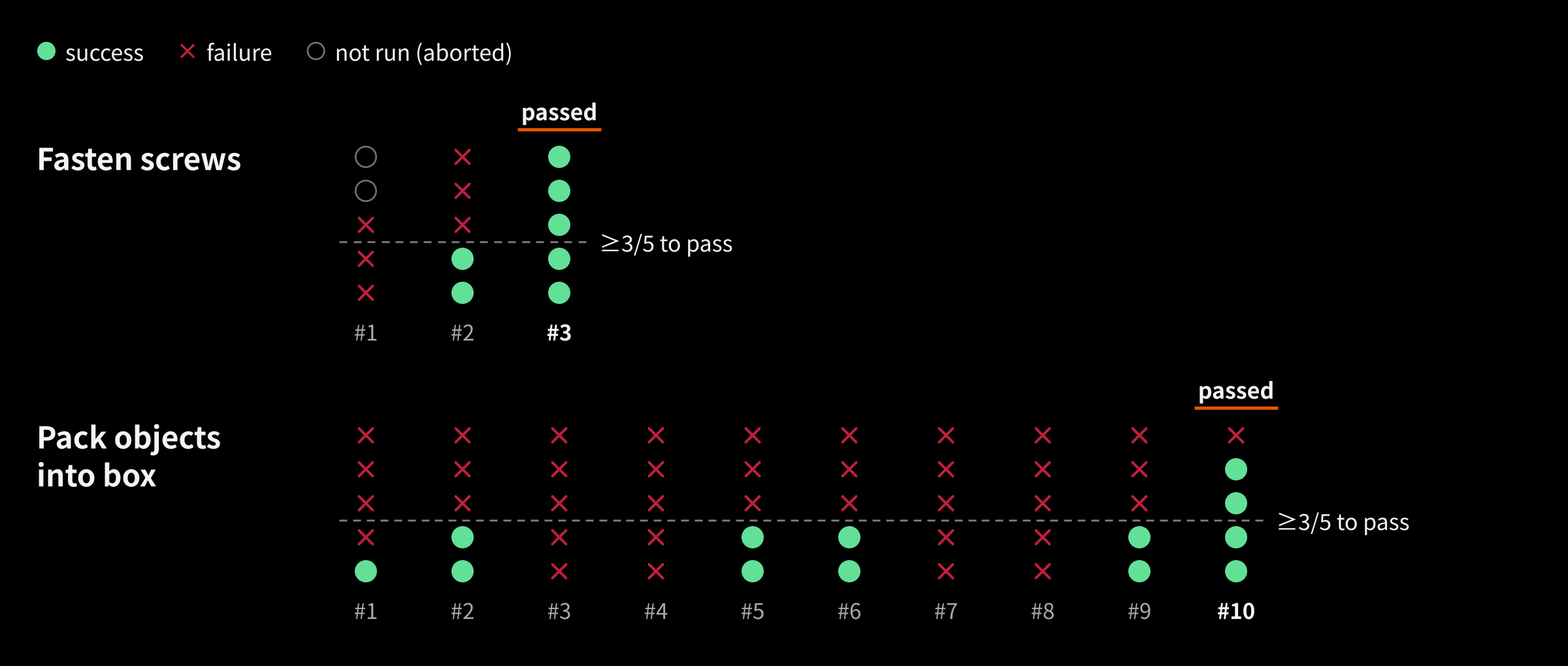
The second is the held-out test. We pre-register 5 layouts that were never used during development and run the frozen program through all of them in a single pass. It passes only if it succeeds on at least 3 of the 5, with no human intervention and no reruns. The results of the held-out test are never fed back to the agent, so that information about the test layouts does not leak into the next trial.
About the evaluation
RoboDojo reports two numbers for each task: the average score (0–100, with credit for partial progress) and the success rate (the fraction of runs that complete the whole task). The official leaderboard protocol is 50 trials × 3 random seeds per task. The held-out tests in this post use our own protocol: 5 pre-registered layouts not seen during development, with a single frozen run. The two are not fully comparable, and the comparison in Section 6 is for reference only.
5. Two case studies
We chose two tasks from RoboDojo that are widely considered hard. RoboDojo is a robot manipulation benchmark released in 2026, with 42 simulated tasks and 18 real-robot tasks. The simulation environment is a tabletop dual-arm robot with one overhead camera and two wrist cameras. Objects are placed differently every time, so memorizing the motions from one successful run does not help.
- Screw fastening ("Fasten screws"): screw nuts of three colors, scattered across the table, onto bolts of the matching color. A nut cannot be screwed all the way down in one go, so the robot has to release it, regrasp it and turn again, several times over. Sometimes a nut is closer to the other hand, and the two arms have to hand it over.
- Box packing ("Pack objects into box"): put four objects, such as a shoe, a toy car, an electric toothbrush and a hammer, into a box, each with its front end pointing left. The shapes and positions of the objects change every time, and the agent has to plan the sequence of operations itself, for example pulling the box closer first or moving things out of the way.
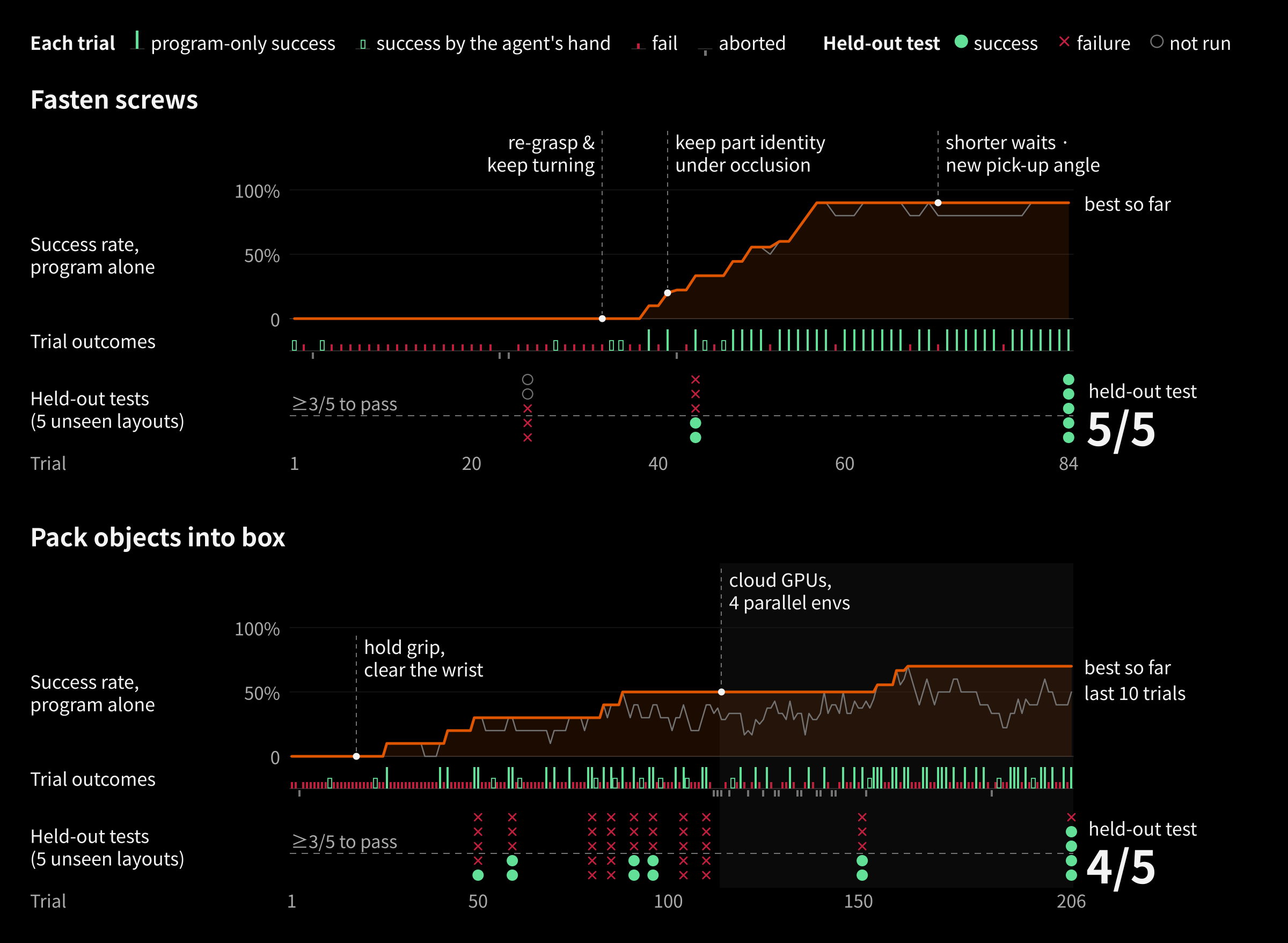
Video 2, at the top of this post, shows the held-out runs. Figure 7 shows how the success rate developed over the course of development for both tasks.
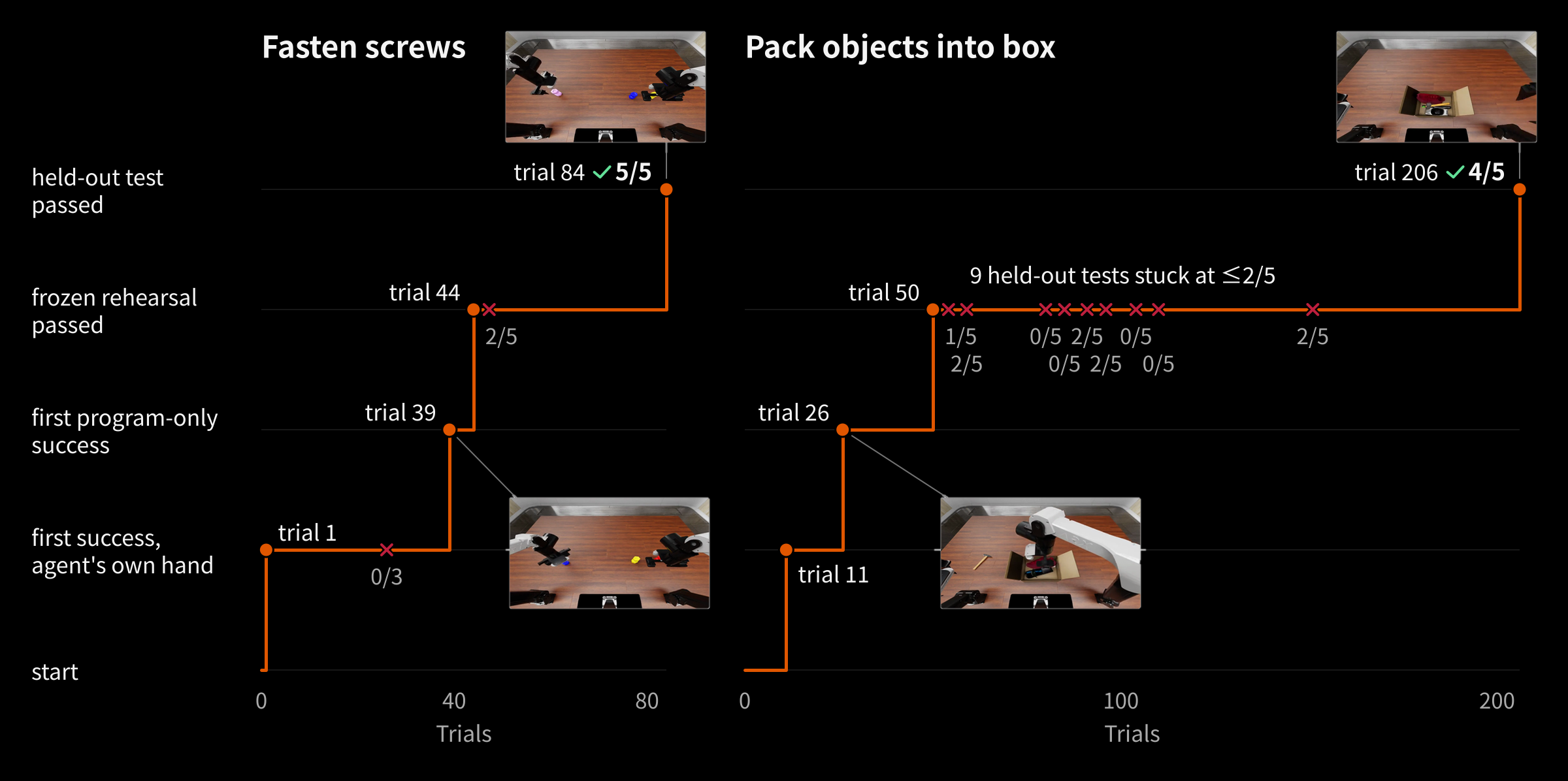
We break the development of a skill into four stages: the agent succeeds hands-on, the program succeeds on its own, the program passes the frozen rehearsal, and it passes the held-out test. Figure 8 shows when each stage was first reached. The sections below follow these four stages and show what was solved at each.
5.1 Screw fastening
Hands-on success. At first, the agent operated the robot while watching the camera images and quickly succeeded twice. This showed that the task could be done, but it did not yet mean the agent had mastered the skill.
Program-only success. After the agent wrote its approach into a program, the first ten versions all failed. In many trials all three nuts looked fastened, yet the trials were judged as failures.
We also took a wrong turn at this stage. After trial 26, we moved to a held-out test before we had enough evidence, failed three times in a row and had to stop. That is where the rule in Section 4.4 comes from: no held-out test without first passing the rehearsal.
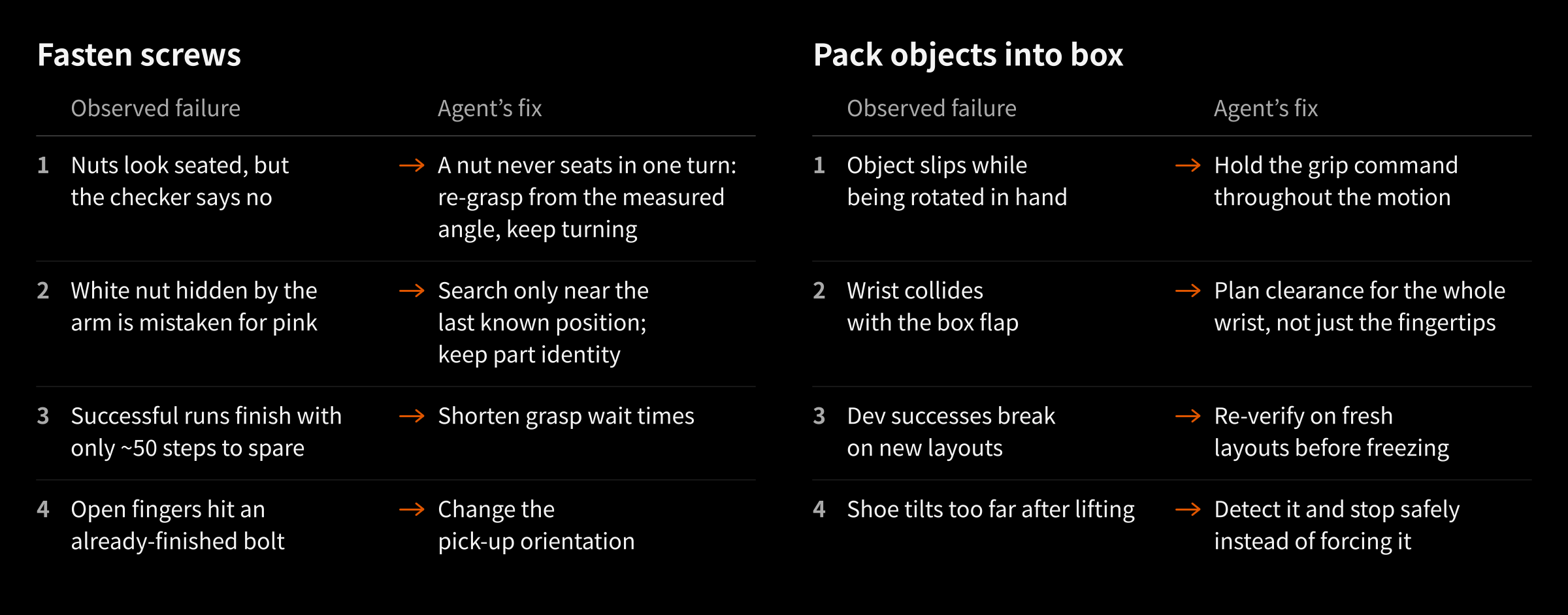
In the 18 additional exploration trials that followed, the agent found two key causes. First, a nut cannot be screwed all the way down in one go, which is why it only "looked fastened." The agent changed the program to use the measured nut angle as the starting point for the next grasp, and to release, regrasp and turn again until the nut was tight. Second, a white part hidden behind the arm was mistaken for a pink one. The agent changed the program to search only near the part's original position, so that it could confirm it was still the same part. At trial 39, the program completed all three pairs on its own for the first time.
Passing the frozen rehearsal. At trial 44, the frozen program passed the rehearsal for the first time, but it succeeded on only 2/5 in the held-out test and did not pass. Following the rules, we did not tell the agent about this result.
Passing the held-out test. We added a budget of 40 more exploration trials. In this phase, even after several successes in a row, the agent made a small fix for every new failure that appeared. It noticed that some successful trials ended with only about 50 steps of budget left, so it shortened the wait before grasping. One version succeeded 5 times in a row and then failed on the 6th: its open fingers had bumped the neighboring pair, which was already fastened. The agent changed the pick-up direction. The revised frozen version succeeded 6 times in a row, and in the held-out test it succeeded on all 5 new layouts.
| Stage | What was done | What it solved |
|---|---|---|
| Hands-on success (trial 1) | The agent operates step by step while watching | Confirmed the task is solvable |
| Program-only success (trial 39) | Regrasp and keep turning; identify parts by position when occluded | Found the real reason the nuts only "looked fastened" |
| Frozen rehearsal (trial 44) | The frozen program passes on its own | Success is reproducible |
| Held-out test 5/5 (84 trials in total) | Small fixes for each new failure; shorter wait; new pick-up direction | Removed long-tail failures |
5.2 Box packing
Box packing is much harder. Development took 206 trials in total.
Hands-on success. At trial 11, operating the robot directly, the agent put all four objects into the box for the first time.
Program-only success. At trial 26, the program completed the task on its own for the first time. This stage taught two main lessons. Objects slip when the wrist rotates while holding them, so the gripper's grasp command has to be held throughout the whole motion. The wrist can hit the box's flap, so clearance calculations must account for the whole wrist, not just the fingertips.
Passing the frozen rehearsal and the held-out test. The hard part came next. The program passed the rehearsal at trial 50 and went into its first held-out test, where it succeeded on only 1/5. Eight more tests followed, and none did better than 2/5.
The program could succeed on its own on development layouts but failed on new ones. This is essentially the same generalization problem VLAs face, occurring at the level of the program. Unlike a VLA's, however, a program's failures can be read: the agent can see which step failed and why.
From trial 114 onward, we moved exploration to cloud GPUs, with up to 4 environments in parallel and a budget that a person raised in stages (capped at 265 trials, of which 206 were used). Tree search helped in this phase. When a branch kept failing on new layouts, the agent could return to an earlier, more stable version and branch again, instead of continuing to patch a chain of versions that only grew more complicated. The version finally selected succeeded on its own twice in a row on new development layouts and passed the frozen rehearsal. On the 10th held-out test it succeeded on 4/5, passing for the first time.
In the one failed trial of that test, the shoe tilted too far after being lifted. The program judged that something was wrong and stopped on its own. In real production, failing this way is far better than pushing ahead regardless.
Figure 9 shows every held-out test, and Figure 10 summarizes what the agent learned from its failures.
5.3 What the two cases show
- Program-only success was the first threshold. When the agent succeeds hands-on, that only shows the task can be done. When it can write a program that succeeds on its own, it has worked out how the task is done.
- Key advances came from understanding the problem differently rather than from trying more times. Examples include discovering that a nut cannot be screwed all the way down in one go, and switching to identifying parts by position instead of color.
- Generalization was the hardest part. Box packing succeeded early in the development environment, yet stayed stuck on new layouts for a long time. Tree search, which can back up and branch, helped most in that phase.
- Isolated held-out tests are necessary. If we had handed the test results straight to the agent, we would likely have ended up with a program that had simply memorized those 5 layouts.
6. Comparison with the public leaderboard
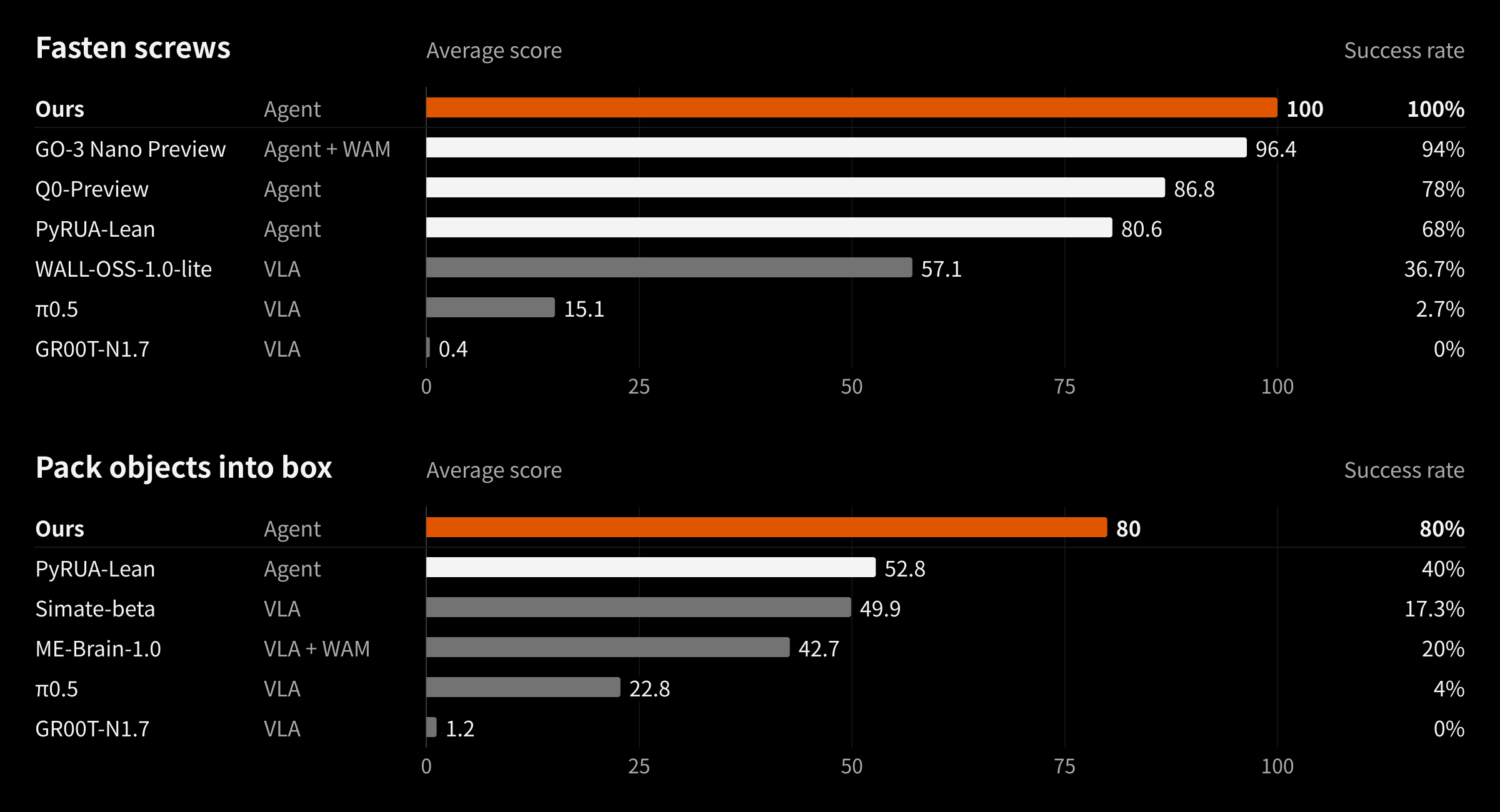
Figure 2, at the top of this post, places our held-out results alongside the public RoboDojo leaderboard.
- Screw fastening: average score 100, success rate 100%. The best public method is GO-3 Nano Preview (96.4 points, 94%), and the best VLA is WALL-OSS-1.0-lite (57.1 points, 36.7%).
- Box packing: average score 80, success rate 80%. The best public method is PyRUA-Lean (52.8 points, 40%), and the best VLA is Simate-beta (49.9 points, 17.3%).
On both tasks, the top scores also come from agent-based methods. Box packing requires planning the sequence of operations and adapting to objects of different shapes, and on this task most end-to-end models succeed less than 20% of the time.
7. Cost
Physical RSI replaces the time people would spend writing programs and collecting data with agent inference and trial time. The table below shows the costs for the two tasks.
| Screw fastening | Box packing | |
|---|---|---|
| Trials during development | 84 | 206 |
| Limit per trial | 1,900 steps (up to about 3 h 10 min) | 1,300 steps (up to about 2 h 10 min) |
| Run time for the 5 held-out trials | About 75 min | About 59 min |
| Total development time | About 32 h | About 40 h |
| Total tokens read and written by the agent | Over 120 million | Over 520 million |
| Share spent re-reading past records | About 98% | About 97% |
| New tokens written by the agent | Over 550,000 | Over 1.7 million |
Of the tokens the agent processed, 97% to 98% went to re-reading past logs, programs and memory, and newly written content made up only 1% to 3%. Most of the cost therefore goes into recovering earlier experience, and organizing memory so that the agent can find the key information while reading less is the most direct way to bring costs down.
8. Limitations and next steps
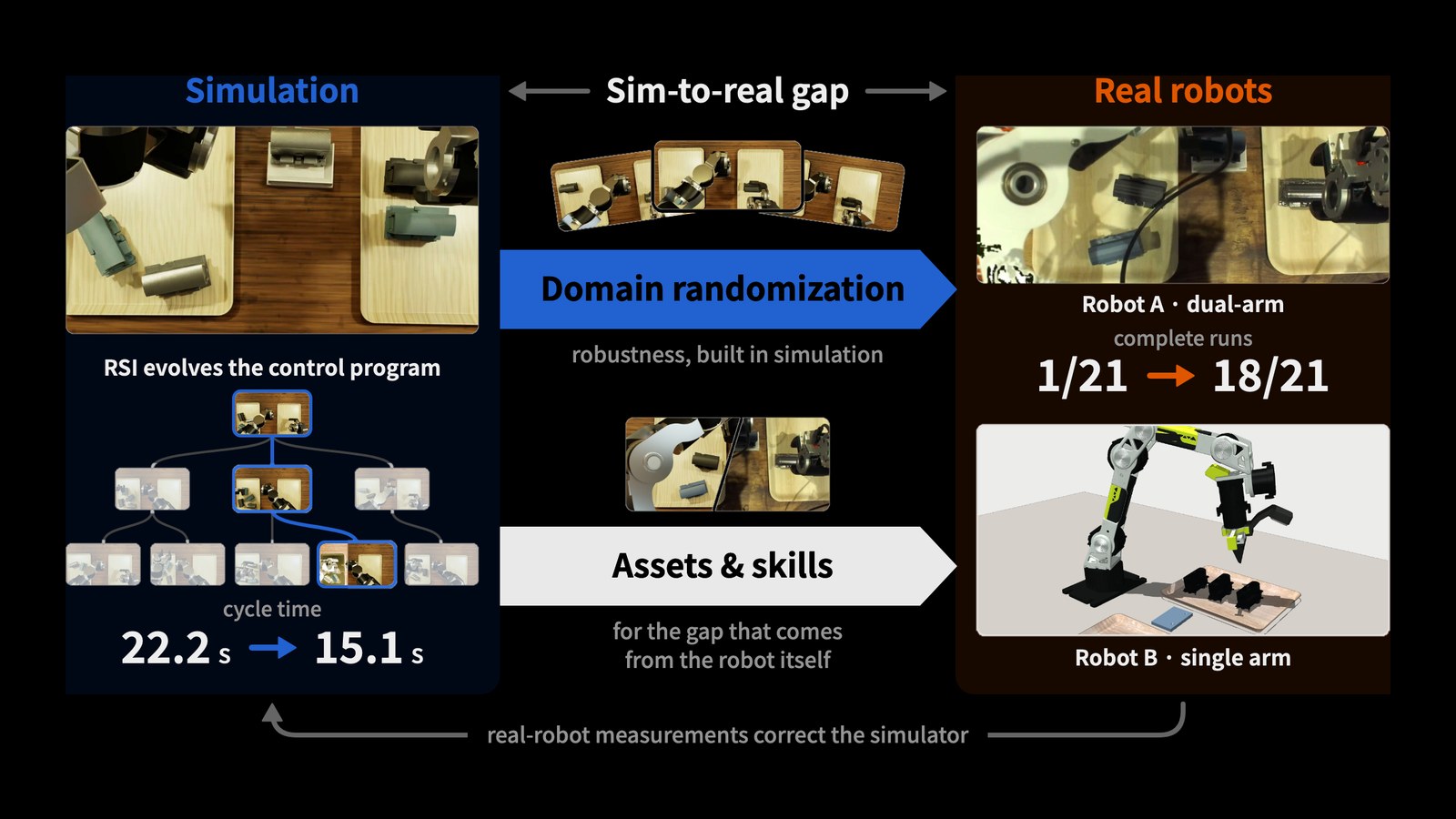
- It is still simulation. A program that succeeds reliably in simulation will run into contact, friction, latency and calibration errors on a real robot. ENPIRE reported that of three agents that solved Push-T (pushing a T-shaped block into a target position and orientation) in simulation, two failed on the real robot. We discuss self-improvement on real robots, and the problems that arise when transferring between different real robots, in our next post.
- The sample is small. Each held-out test has only 5 layouts and does not follow the official protocol, so the statistical confidence intervals are wide.
- Humans are still in the loop. People set the budget, the gate rules and the success criteria, and for box packing a person also added budget in stages.
- It is not yet full RSI. Our system autonomously improved its program and memory on a single task, which is roughly L1 on the scale described in Section 3. Memory carries over to the next task, a small step toward L3. But the improvement method itself (L2) has not yet been systematically improved, and we do not yet have the controlled evidence that L5 requires. This is the focus of our next phase.
- The cost is not low. A single task takes hundreds of millions of tokens and tens of hours, though this cost will fall as models get cheaper.
Next, we will apply the same framework to a third task, "putting tools away," while moving the experiments onto real robots and studying how skills can be reused across tasks and across robots.
Closing thoughts
Until now, teaching a robot something new has meant either an engineer writing a program or an operator collecting data. Both depend on people. Agent-as-a-Policy combined with Physical RSI lets AI try things out and fix them on its own, and write the results into programs that people can read, inspect and reuse. This approach is still at an early stage and is not cheap, but its progress depends mainly on compute and foundation models, and both are advancing quickly. We will keep working in this direction.